
Last Updated: 25 October 2026
Quick Summary
Assorted chocolates are mixed selections of individual pieces, each built around a different centre and coating, so one box offers several distinct tastes. Most boxes group those pieces into three flavour families: fruit, nut and caramel, with fillings such as ganache, praline, nougat and fruit centres.
- Ganache is a smooth blend of chocolate and cream and forms the base of most truffles.
- Praline originally meant a nut paste, usually almond or hazelnut, ground with sugar.
- Domed pieces usually hold ganache or praline, while flat squares tend to be caramel or nougat.
- Store assorted chocolates at a steady 15°C to 18°C, away from strong smells and the fridge.
- Build a selection with two pieces from each flavour family plus one wildcard you would not normally choose.
Table of Contents
- What Flavours Are in Assorted Chocolates?
- The Main Types of Chocolate Fillings
- Fruit, Nut and Caramel: The Three Flavour Families
- How to Identify Chocolate Flavours Before You Bite
- Chocolate and Wine Pairing: Matching Flavours to Drinks
- How to Store Assorted Chocolates So the Flavours Stay True
- Building Your Own Assorted Selection
- Frequently Asked Questions
What Flavours Are in Assorted Chocolates?
Assorted chocolates are a mixed selection of individual pieces, each built around a different centre and coating, so one box offers several distinct tastes rather than one repeated flavour. Most boxes group those pieces into three families: fruit, nut and caramel. Open a good assortment and you should be able to taste the difference between a tart berry centre and a salted caramel within the same sitting.
That variety is the whole point. A single bar gives you one idea done well. An assortment lets you compare.
At Sabor Chocolates, we build our collections around exactly this principle: distinct pieces, each with a clear flavour identity, rather than twelve variations on the same sweet base.
Below, we break down the fillings you will meet, the three flavour families they fall into, and how to taste and store them properly.
The Main Types of Chocolate Fillings
Chocolate fillings fall into a handful of recognisable types, and learning to spot them tells you most of what a piece will taste like before you bite. The coating matters, but the centre decides the experience.
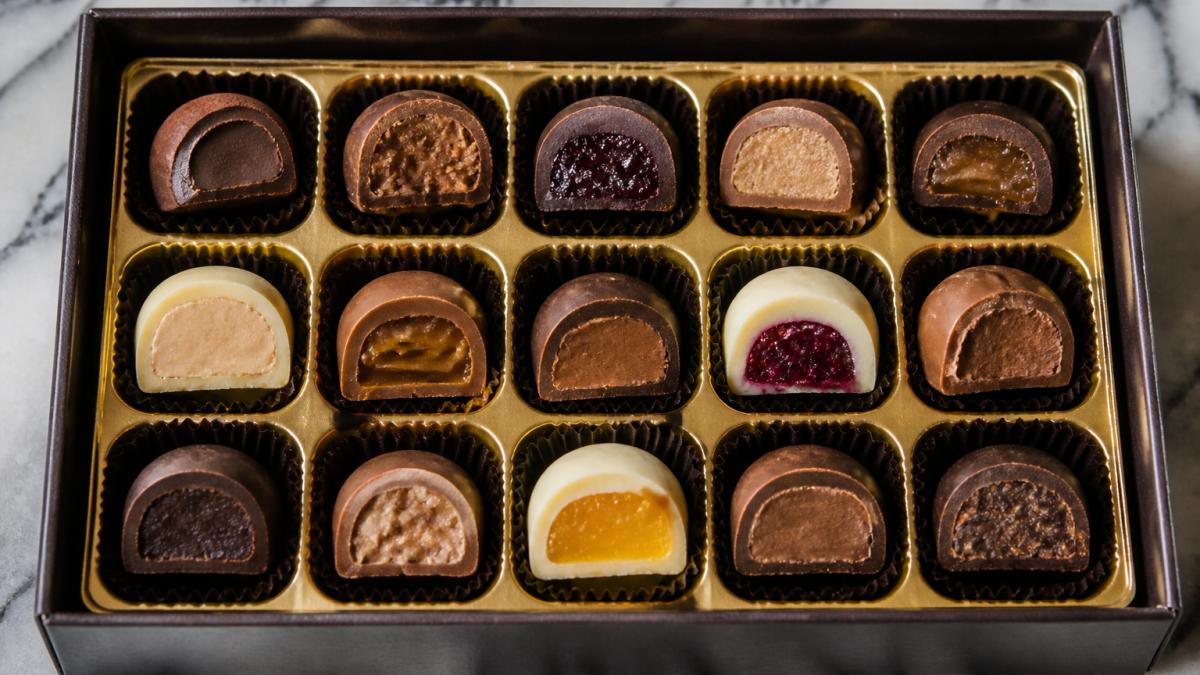
Ganache, Truffle and Praline
Ganache is a smooth blend of chocolate and cream, and it forms the base of most truffles. It tastes rich and melts quickly, so it suits dark chocolate coatings best.
Praline originally meant a nut paste, usually almond or hazelnut, ground with sugar. A good praline tastes toasted and deep rather than simply sweet.
Caramel, Nougat and Fruit Centres
Caramel centres range from soft and flowing to firm and chewy, often finished with a pinch of salt to stop the sweetness running away with itself.
Nougat adds chew and air, usually with nuts folded through. You can see a box built around these patisserie-style fillings. Fruit centres can be ganache-based, jelly-based or pieces of real fruit, and they give a box its sharpness and lift.
Fruit, Nut and Caramel: The Three Flavour Families
Almost every piece in an assortment belongs to one of three flavour families, and knowing which is which helps you build a box that actually balances.
- Fruit: raspberry, cherry, citrus and berry centres. These cut through richness and refresh the palate.
- Nut: praline, whole almonds, hazelnuts and pistachio. These add depth, toast and crunch.
- Caramel: soft caramel, honeycomb, toffee and salt. These bring warmth and a long finish.
A box with only one family tires quickly. Two pieces from each family give you contrast without confusion.
Our The Orchard sits squarely across two of these families, pairing tart sour cherry with toasted almond in dark chocolate.

Almost every piece in an assortment belongs to one of three flavour families, each bringing something different to the box.
| Family | Typical flavours | What it adds |
|---|---|---|
| Fruit | Raspberry, cherry, citrus and berry centres | Cuts through richness and refreshes the palate |
| Nut | Praline, whole almonds, hazelnuts and pistachio | Depth, toast and crunch |
| Caramel | Soft caramel, honeycomb, toffee and salt | Warmth and a long finish |
How to Identify Chocolate Flavours Before You Bite
You can identify most flavours in an assortment before tasting, using three cues: the shape, the coating and any marking on top.
- Shape often signals the filling. Domed pieces usually hold ganache or praline; flat squares tend to be caramel or nougat.
- Coating tells you about intensity. Dark chocolate usually wraps fruit and nut centres; white chocolate nearly always signals something sweet and delicate.
- Surface markings, such as a piped swirl or a single nut on top, frequently hint at the dominant ingredient.
Smell comes next. Our guide to choosing artisanal chocolate goes deeper into identifying and choosing flavours. Bring the piece close and notice whether you get cocoa, cream, fruit or nuts first. That first impression usually matches the centre.
Chocolate and Wine Pairing: Matching Flavours to Drinks
Chocolate and wine pairing works on one simple rule: match the weight of the chocolate to the weight of the wine, then let sweetness and acidity do the rest.
- Dark chocolate with fruit centres suits a fruity red with soft tannins.
- Milk chocolate with caramel or honeycomb pairs well with a nutty fortified wine.
- White chocolate needs something with fresh acidity to cut the cream, such as a light dessert wine.
The common mistake is reaching for the biggest red in the rack. High-tannin wines clash with sweet centres and leave a bitter edge. Serve both at room temperature and take small sips between pieces.
For a fuller walkthrough of matching flavours to drinks, see our pairing guide.
How to Store Assorted Chocolates So the Flavours Stay True
Store assorted chocolates in a cool, dry, dark place at a steady temperature, ideally between 15°C and 18°C, and keep them away from strong smells.
Chocolate absorbs odours quickly. A box left beside coffee or spices will taste of them within days.
- Keep the box sealed in its original packaging or an airtight container.
- Avoid the fridge: condensation dulls the surface and blunts flavour.
- Keep away from direct sunlight and radiators.
- Eat within the recommended window rather than saving the box for months.
Watch out: if your chocolate develops a pale grey film, that is fat bloom from temperature swings. It is harmless, but the texture will feel grainier than it should.
Building Your Own Assorted Selection
Building your own selection comes down to balance: pick two pieces from each flavour family, then add one wildcard you would not normally choose.
Here is how we would do it:
- Choose one fruit-forward piece for lift
- Choose one nut or praline piece for depth
- Choose one caramel or honeycomb piece for warmth
- Add a dark chocolate piece to reset the palate
- Include one piece you have never tried before
That structure gives you contrast in every other bite, which is what makes an assortment worth eating slowly rather than all at once.
You can browse the full range and build a box around the families above.
Frequently Asked Questions
What flavours are usually in an assorted chocolate box?
Most assorted chocolates fall into three broad families: fruit, nut and caramel. Fruit centres use raspberry, cherry or citrus, often against white or dark chocolate. Nut fillings include praline, whole toasted almonds, hazelnut and pistachio. Caramel and honeycomb bring sweetness and crunch, frequently finished with sea salt. Many boxes also carry truffles and ganache, which are softer and richer. The exact mix depends on the maker, so a good assortment usually balances sharp fruit, roasted nuts and creamy caramel so no single note dominates.
What is the difference between praline and truffle chocolates?
Praline is a filling made from ground nuts, usually hazelnut or almond, mixed with sugar and sometimes chocolate, giving a dense, grainy-smooth texture. Truffles have a soft ganache centre of chocolate and cream, often rolled in cocoa or coated in a shell. Pralines tend to be firmer and nuttier, while truffles are richer and melt more quickly. In an assorted box, praline usually holds its shape well, whereas truffles need cooler storage and a shorter shelf life.
How can you tell what flavour an unlabelled chocolate is?
Start with the shell: dark chocolate usually signals a fruit or intense filling, milk chocolate leans towards caramel, honeycomb or praline, and white chocolate often carries berry or pistachio. Look at the shape and any decoration, since many makers use moulds or drizzle patterns to mark different centres. Smell the chocolate before biting, then taste slowly and let it melt. If you are still unsure, cut it in half with a warm knife to inspect the filling before committing.
Do assorted chocolates contain nuts, and how should you store them?
Many assortments include nuts, whether as whole pieces, praline or toasted inclusions, so always check the label if you have an allergy. For storage, keep assorted chocolates in a cool, dry place between 15°C and 18°C, away from direct sunlight and strong odours, since chocolate absorbs surrounding smells. Airtight containers help. Avoid the fridge for everyday storage because condensation can dull the surface and affect texture. If your kitchen runs warm, a cool cupboard is safer than a refrigerator shelf.
Choosing well comes down to understanding what sits inside each piece, not just how the box looks on the table. Sabor Chocolates makes that easier with curated collections built around distinct flavour profiles, limited seasonal offerings, and elegant presentation for gifting. Explore the seasonal collections and find a box that suits how you actually like to eat chocolate. Get started with Sabor Chocolates and taste the difference a considered selection makes.
